What Athena does
Athena builds apps from a plain description, and troubleshoots apps you deploy from your own repository.
Athena is an AI engineer built into every project. Tell it what your app should do in plain words, and it writes the code, sets up the machine and services the app needs, tests everything on that machine and puts the app online. When you want a change, you ask.
You don't need to know how to program. Athena describes its work in terms of your app, such as "Building your stock list, deliveries and low stock warnings". File names and commands stay out of the way unless you turn on Details.
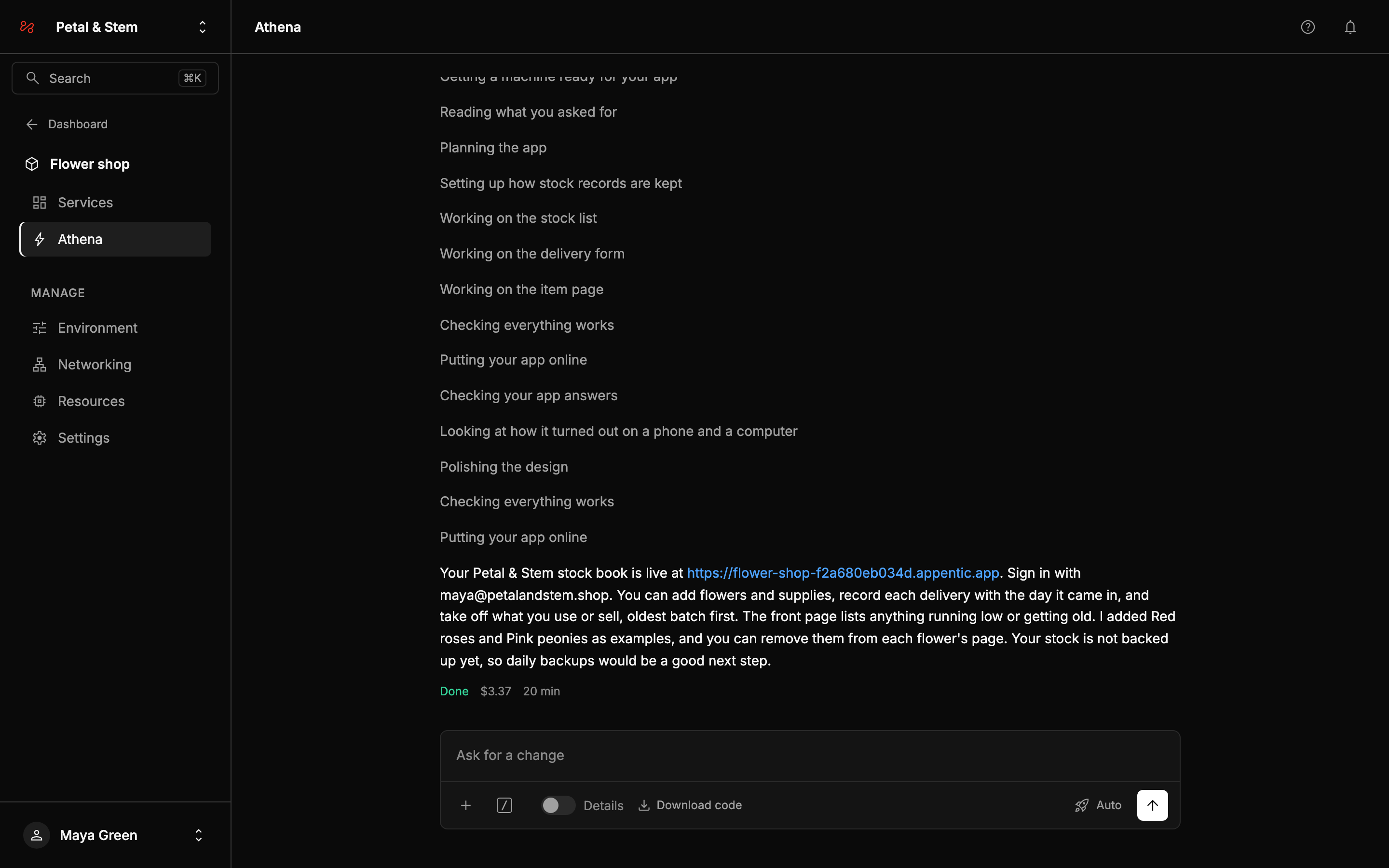
To open it, choose Athena in the project's sidebar.
Two jobs
- Build and change an app. In a new project, Athena builds the app from your description and makes the changes you ask for afterwards. You can also change the app's services and settings yourself, and Athena builds on your changes. See Build an app and Change your app.
- Troubleshoot your own app. In a project whose web service deploys your own GitHub repository, Athena doesn't build. It finds out why the app is failing, fixes settings itself, and can push a fix to your code once you allow it. See Troubleshoot your app.
Modes
The mode picker beside the send button sets how much Athena does on its own. Shift+Tab in the box switches between them.
| Mode | What it does |
|---|---|
| Auto | Works on its own and asks only what only you can decide. This is the default. |
| Manual | Asks before it deploys, pushes a fix, changes a setting or adds anything that costs money. |
| Plan | Looks into your request and shows you a plan, changing nothing. |
See Modes.
What happens when you ask
- Questions, if it has any. Things only you can decide, such as who signs in, all at once.
- Building. It plans the app, sets up what it needs and writes it.
- Checking. It tests the app on your project's machine before anything goes online.
- Putting it online and trying it. It opens the live app on a phone and a computer, tries the main thing it's for, and tells you what it added.
See Build an app for each step.
What it builds
Athena builds web apps that keep your data in a database, work on phones and computers, and, when they need them, have sign-in, background work and photo uploads. For developers: these are Feather apps, written in Python with a Postgres database. People sign in with a six-digit code sent to their email. Appentic sends those emails for you, so there are no passwords and nothing to set up.
That covers most things a business runs on, such as stock, bookings, orders, client lists, internal tools and small online services.
The result is an ordinary app in an ordinary Appentic project. Its logs, metrics and environment variables are on the project's pages like any other, and the code is yours. See Your app's pages and Your code.
Pictures, files and commands
You can attach screenshots, files and links for Athena to follow, type / for commands such as /plan, /fix and /undo, and dictate instead of typing. See Attachments, commands and dictation.
Where it runs
Everything Athena writes, including its tests, runs only on your project's machine. No other customer's app runs on it.
Limits
- One request at a time in a project. While Athena works, the box offers Stop instead of send. Ask for the next change once the current one has finished.
- About 45 minutes of work per request. Time spent waiting for your answers doesn't count. If a request runs out of time, the code it wrote is kept and your next request carries on from there.
- A queue when Athena is busy. Your request may show Waiting for a free slot for a while before it starts. If it can't start within 30 minutes, it stops and asks you to try again.
- Your credits. Athena spends credits as it works, and stops before your balance reaches what keeps your projects running. See Costs.